Sugar Retention Pathway
Genes
Compounds
Output
phytoglycogen
sucrose
reducing sugars
Tender sweet kernel textureClassic corn sweetnessStays sweet up to 4 days
Lipoxygenase / Green Aroma Pathway
Genes
Compounds
Output
n-hexanal
1-octen-3-ol
Grassy fresh-cut aromaEarthy mushroom-like note
Carotenoid & Kernel Colour Pathway
Genes
Compounds
Output
lutein
zeaxanthin
decylaldehyde
β-ionone
Yellow kernel colourDeep golden kernel pigmentWaxy fatty cooked-corn noteFaint floral violet undertone
Thiazole / Sulfur Volatile Pathway
Genes
Compounds
Output
2-pentylthiazole
Roasted cooked-corn aroma
Kernel Size & Ear Architecture
Genes
Compounds
Output
kernel cell expansion factor
Plump full-size kernel
Maïs Doux
Sweet Corn
Details
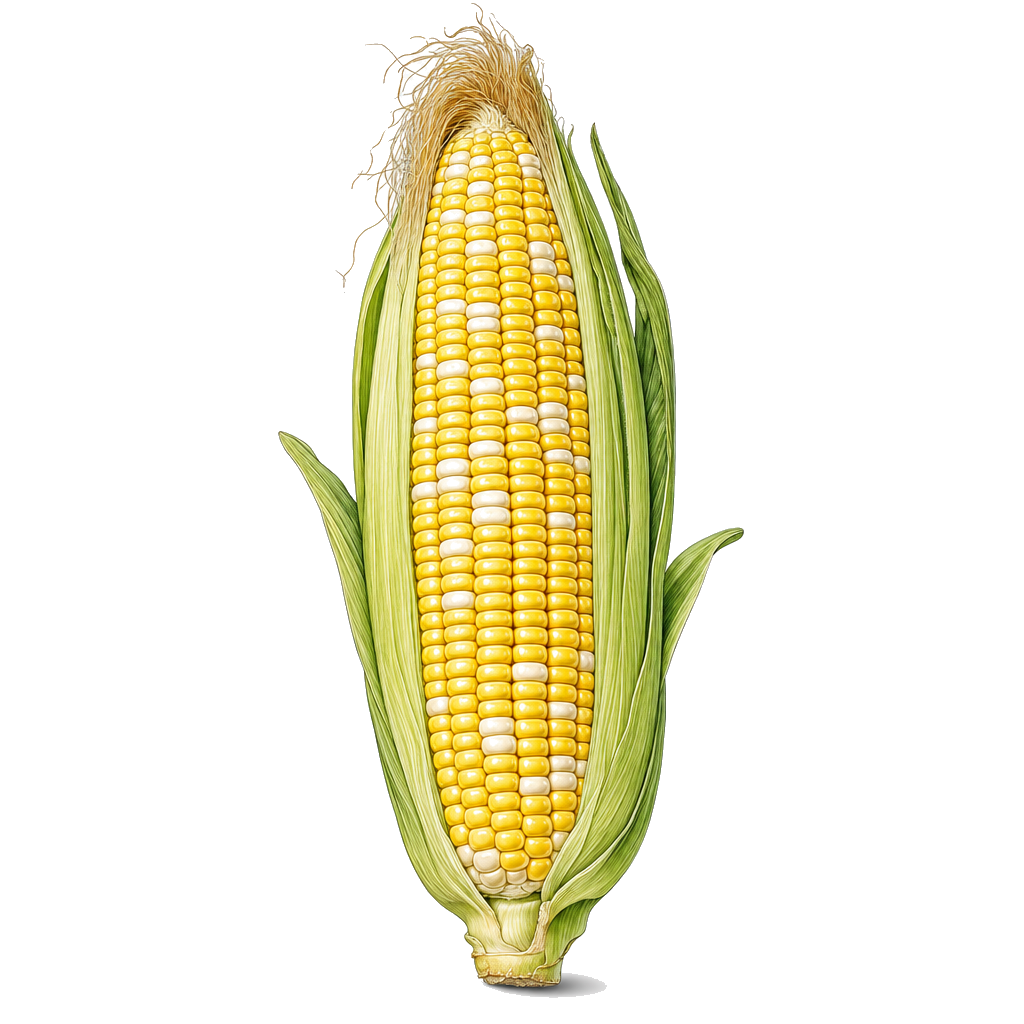
Maïs Doux is a classic French sweet corn type carrying the sugary-enhanced (se) gene, producing bicolor (yellow and white) ears 15–20 cm long. In the heterozygous se background, kernel sugar content reaches 14–22%; homozygous se+ kernels can achieve 22–35% sugar. Harvested at the 'milky' stage, roughly one month after female flowering, kernels stay sweet for up to 4 days post-harvest. Key volatile flavor compounds include n-hexanal, 1-octen-3-ol, decylaldehyde, and 2-pentylthiazole.
France
partial
Root architecture
fibrousmixed growth
Depth
60–150 cm
typical 90 cm
Spread
30–60 cm
Growing profile
Germination
Days
5–10
Ideal °C
20°
Range °C
10–32
Days to harvest
70–89days
from direct sowHarvest window
4 days
Picking
Staggered
Seasonality
Sow
springsummer
Grow
springsummer
WinterFrost sensitive
medium confidenceWikipedia Maïs doux (variety comparison: Maple Sweet 70 days, Bodacious 75 days, Tuxedo 75 days, Peaches & Cream 83 days, Kandy Korn 89 days); Graines del Païs (ear length 15–20 cm); species-level agronomic standards
Flavor pathway activity
Each pathway is a biological "assembly line" inside the plant that produces specific flavor compounds. Higher activity = more of that flavor in the fruit.
Sugar Retention Pathway75%
Lipoxygenase / Green Aroma Pathway55%
Carotenoid & Kernel Colour Pathway60%
Thiazole / Sulfur Volatile Pathway45%
Kernel Size & Ear Architecture60%
Key figures
Kernel Sugar (se het.)
14–22%
Ear Length
15–20 cm
Days to Maturity
70–89 days
Post-Harvest Shelf Life
~4 days
Sensory profile
18
Brix
high
Sweet
low
Acid
low
Umami
Dominant notes
sweet corngrassy greenbutteryslightly nuttylight sulfurous
Sweet
8
Green / Grassy
6
Fatty / Waxy
5
Earthy / Mushroom
4
Sulfurous / Thiazole
4
Fruity
2
Aroma compounds
Volatile flavor compounds for sweet corn were characterised by GC-MS and GC-IMS (Zhang et al. 2022). Four key compounds were identified by Relative Odour Activity Value (ROAV) analysis as the primary aroma drivers in Zea mays kernels: n-hexanal (grassy/green), 1-octen-3-ol (earthy/mushroom), decylaldehyde (fatty/waxy), and 2-pentylthiazole (roasted corn). No variety-specific GC-MS quantification (µg/kg FW) was found for Maïs Doux specifically; confidence is therefore medium for all compounds.
n-Hexanal
Grassy, fresh-cut green
1-Octen-3-ol
Earthy, mushroom, damp
Decylaldehyde (decanal)
Waxy, fatty, cooked corn
2-Pentylthiazole
Roasted corn, cooked vegetable
Skimmin (6-hydroxy-7-methoxycoumarin glucoside)
Non-volatile quality marker; linked to kernel sweetness
N′,N″-Diferuloylspermidine
Non-volatile phenolic; kernel quality and antioxidant marker
Ideal soil conditions
Sweet corn (Zea mays) is a warm-season grass requiring fertile, well-drained loam soils rich in nitrogen for rapid vegetative growth and high kernel sugar content. Adequate potassium is critical for sugar transport into kernels; phosphorus supports early root establishment. The se gene background amplifies sugar retention, but mineral nutrition — especially consistent moisture during kernel fill — is equally important for achieving the 14–22% sugar potential.
pH
6.0–6.8
Nitrogen (N)
150–200 kg/ha total
Phosphorus (P)
60–80 kg/ha P₂O₅
Potassium (K)
120–160 kg/ha K₂O
Soil texture
Sandy loam to loam
Soil moisture
Field capacity (60–80% WHC)
Organic matter
≥3%
Soil temperature at planting
≥12°C
Recommended microbial interventions
Rhizophagus irregularisBOOST
Improves phosphorus and zinc uptake, supporting the sugar-loading enzymes that keep se kernels sweeter at harvest.
Azospirillum brasilenseBOOST
Promotes deeper, denser root growth and supplements nitrogen supply, reducing the fertiliser needed while maintaining kernel sugar potential.
Bacillus subtilisSUPPORT
Primes the plant's immune system against common sweet corn leaf diseases (northern leaf blight, grey leaf spot), reducing yield loss without fungicide residues.
Trichoderma harzianumSUPPORT
Suppresses soilborne root rots (Fusarium, Pythium) and improves early root establishment, ensuring an even stand for consistent ear development.
These are variety-level recommendations - they apply to all Maïs Doux plants. Your soil diagnostic will refine this further based on your specific conditions.
0% complete
Analyze your soil to optimize growing conditions
Re-run AI research and rebuild this variety profile
4 callouts en français — récolte, poids, durée, sucre
Botanical icon · garden scene · 3D splat — generate all in one click
Or check "+ 3D splat" above to chain it automatically after image generation